Player self-service
Players respond to availability from their phone and view only the match details and published assignment they need.
Built for USTA adult captains
Court Chemist turns availability, doubles and singles ratings, partner history, playing-time goals, and captain preferences into ranked lineups with tradeoffs you can review.
Built by a USTA captain for the decisions spreadsheets cannot make.
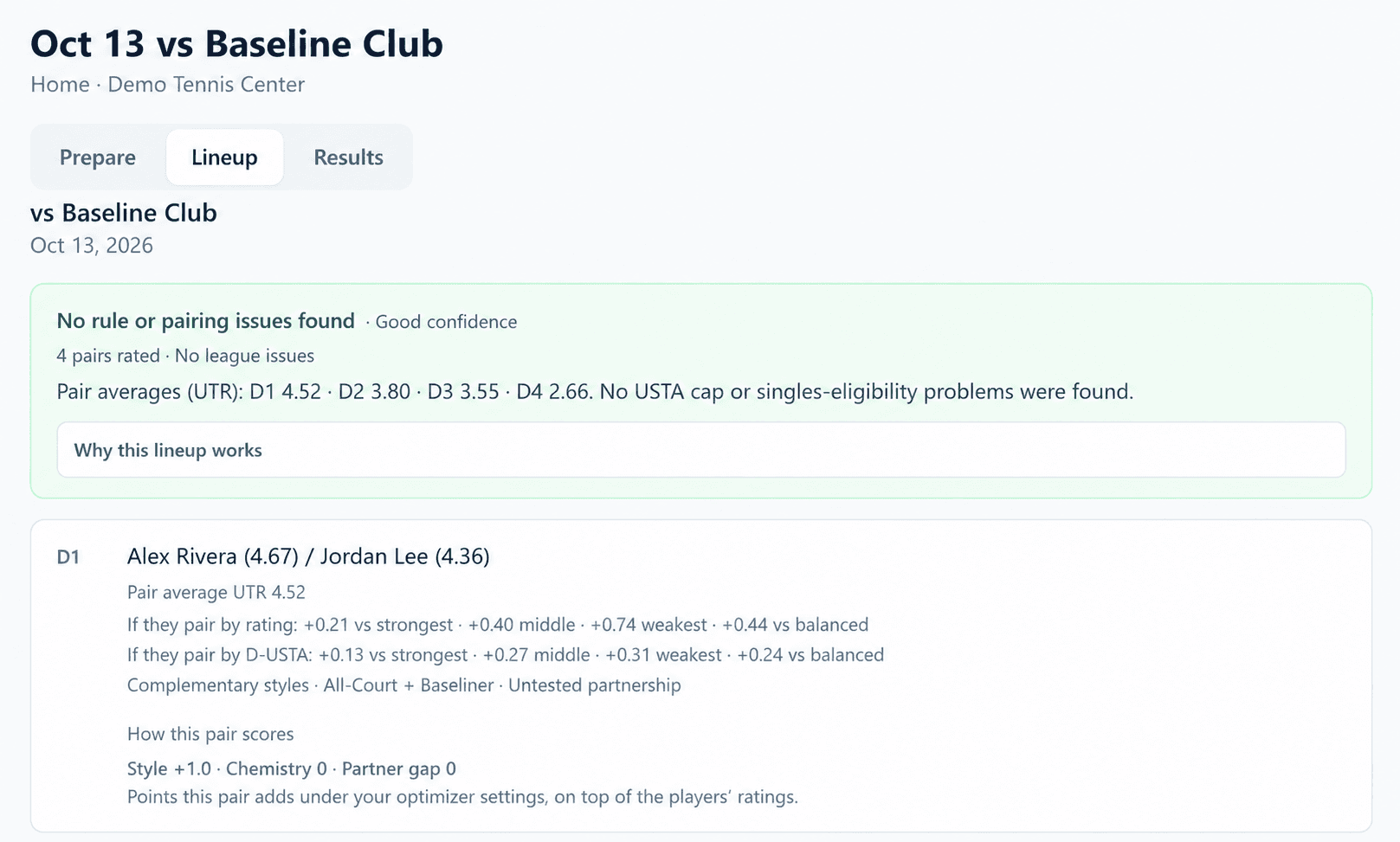
Match week should not feel like a second job
Every week, captains balance who is available, who needs to play, which partners work, how the matchup looks, and how aggressive the team should be. Most tools record the final lineup. Court Chemist helps you decide it—without pretending there is one perfect answer.
Match week today
With Court Chemist
From roster to ready
Add or import your roster, ratings, schedule, and opponents once, then carry that context through the season.
Track availability, confirm you can fill every court, and review missing or out-of-date rating information before building.
Player self-service for availability
Compare ranked options, review each court and matchup, adjust the assignments, then copy the finished lineup for your team message.
One-click publishing and player notifications
More than a lineup builder
Court Chemist evaluates the factors captains already think about, then makes the tradeoffs visible. You remain the captain. The product gives you stronger options and better information.
What goes in
What comes out
Each option shows the court assignments, playing-time impact, chemistry, tradeoff, warnings, and how much recorded data supports the recommendation. Expand the scoring details when you want the underlying factor-by-factor breakdown.
Opponent scenarios stay visible beside the lineup but do not quietly change the optimizer score. You decide how much matchup information should influence the final call.
Inside Court Chemist
Move from the season schedule to a lineup, compare alternatives, and inspect the tradeoffs without losing the match context. Every image below is a real product screen populated only with fictional demonstration data.
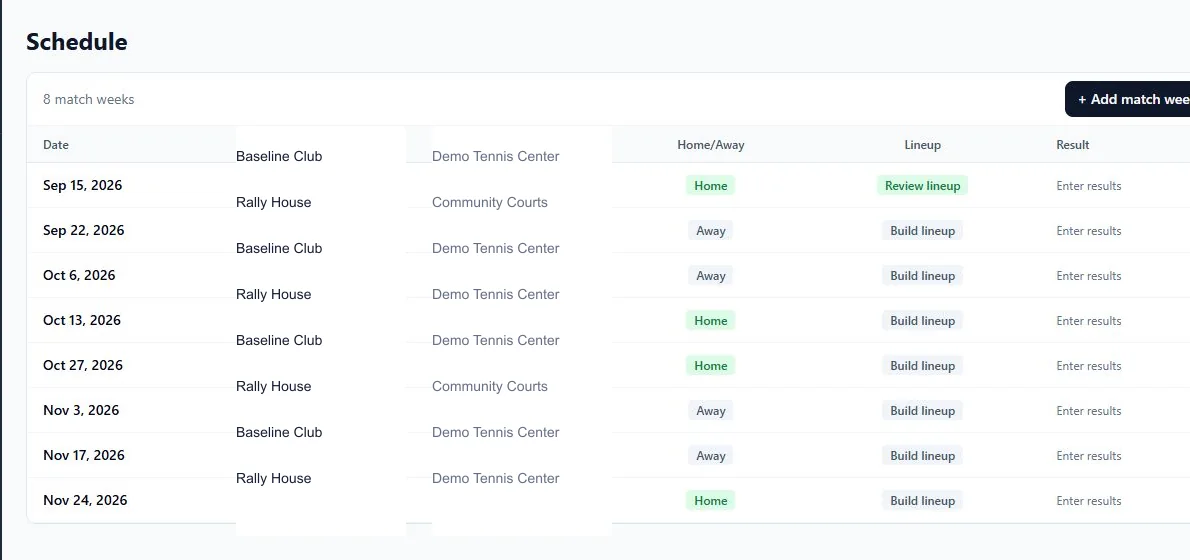
Move from each match week to its lineup and results without rebuilding the context.
Swipe the product screen to inspect details.
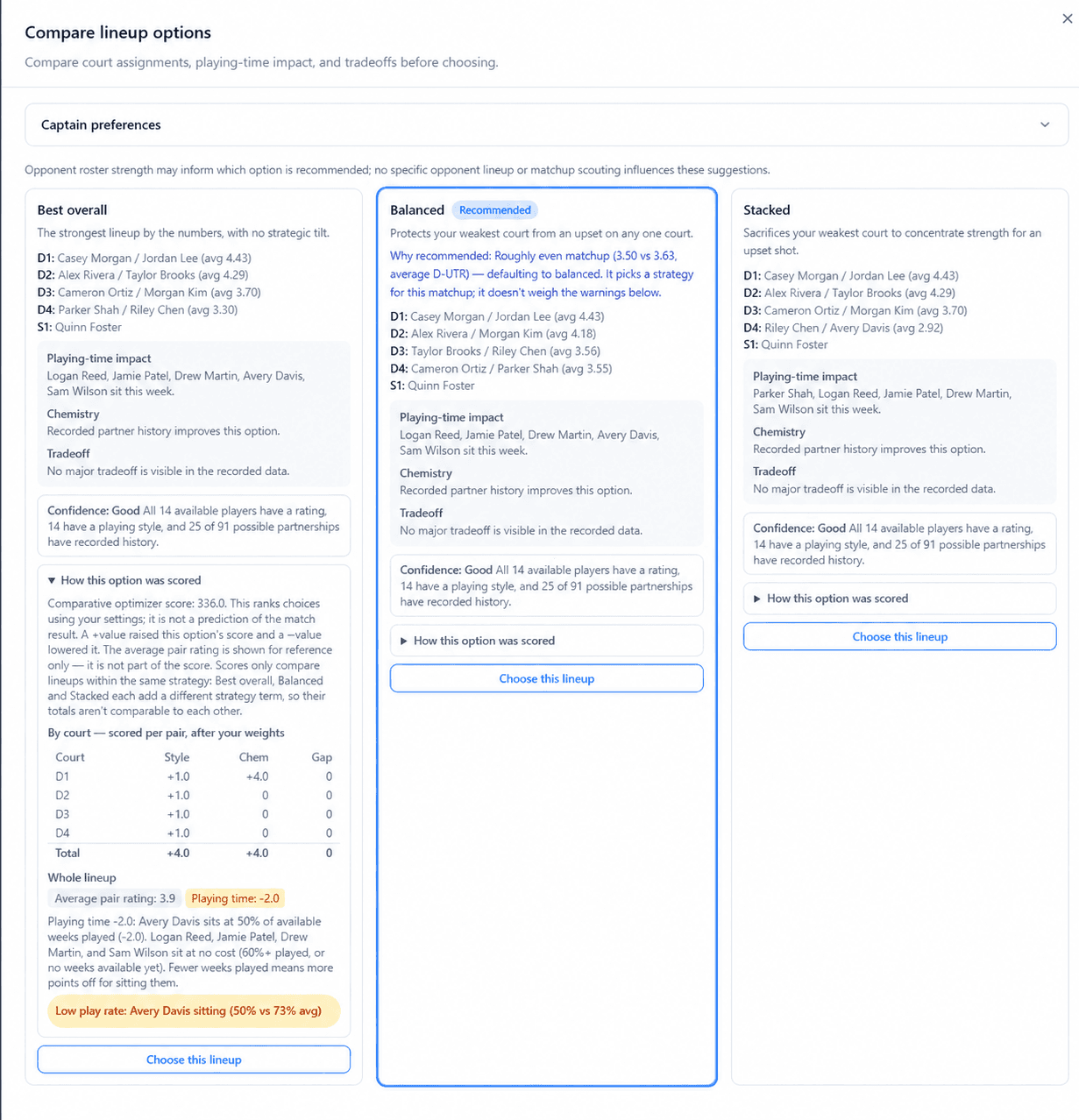
Review three viable strategies, see why one is recommended, and inspect playing-time impact and scoring before choosing.
Swipe the product screen to inspect details.
What you get
Compare ranked options with confidence, playing-time impact, partnership context, warnings, and a scoring breakdown.
See likely opponent pairs before the exchange, then compare the recorded matchup using ratings frozen for that match.
Track play rate and consecutive sits so one weekly decision does not create a season-long problem.
Results update partner history, helping future recommendations reflect what has actually worked on court.
Today, captains manage availability and copy a finished lineup for text or email. The next beta milestone connects that workflow to the players without exposing captain strategy.
Players respond to availability from their phone and view only the match details and published assignment they need.
The captain reviews the final lineup, chooses the recipients, and deliberately publishes it. Drafts and optimizer experiments are never sent.
Where this came from
Court Chemist began as a purpose-built system for managing a real USTA adult team: availability, changing ratings, partner history, playing-time balance, and the difficult question of who should play each week. The product is now being shaped with founding captains who want a better way to make those decisions.
Captain beta
Help shape a lineup tool built around the decisions captains make every week. Founding captains receive personal setup help and direct access to the person building the product.
Questions captains ask
No. Court Chemist is an independent product for USTA adult league captains and is not affiliated with or endorsed by the United States Tennis Association. USTA is a trademark of its respective owner.
No. It provides ranked options and explains the tradeoffs. The captain can add constraints, adjust assignments, or build the lineup manually.
Depending on the team's settings and available data, Court Chemist can consider court-specific ratings, availability, partner chemistry, playing styles, playing-time balance, consecutive sits, captain preferences, and lineup philosophy. Opponent scenarios are shown separately so they never influence a recommendation invisibly.
Yes. The lineup builder can show likely opponent pairings and rating gaps before the exchange, then preserve the recorded matchup for later review. AI-enabled captains can also use the Court Chemist MCP to explore opponent data. These insights support the captain's analysis; they are separate from the core lineup score.
Yes. Court Chemist supports structured Excel imports for player ratings, availability grids, opponent rosters, and league results. During the captain beta, we will personally help you map the sheet you already use to a supported format.
Court Chemist supports seasons with configurable combinations of doubles and singles courts, including court-by-court levels for tri-level play. It checks configured pair caps, line levels, and singles eligibility while leaving the final decision with the captain.
No. Court Chemist is currently a captain-facing product. Player self-service is planned for the captain beta, and players will not need to pay to respond or view a published assignment.
Yes. The captain always makes the final decision and can edit assignments or apply constraints.
No. Lineup recommendations and captain notes stay inside the team's private account.
Captains can enter or import rating data they already track and can connect supported rating sources. Doubles lineups use Doubles UTR and singles use Singles UTR; estimated USTA Dynamic is shown only as a comparison. Court Chemist does not receive official USTA dynamic ratings, and any third-party estimate remains an estimate.
Current ratings inform future planning. When a match is finalized, Court Chemist freezes the ratings used for that matchup so historical comparisons do not drift as players' ratings change. It also warns the captain before finalizing when relevant rating data is missing or may be out of date.
Bring the information you already manage into one decision you can understand.